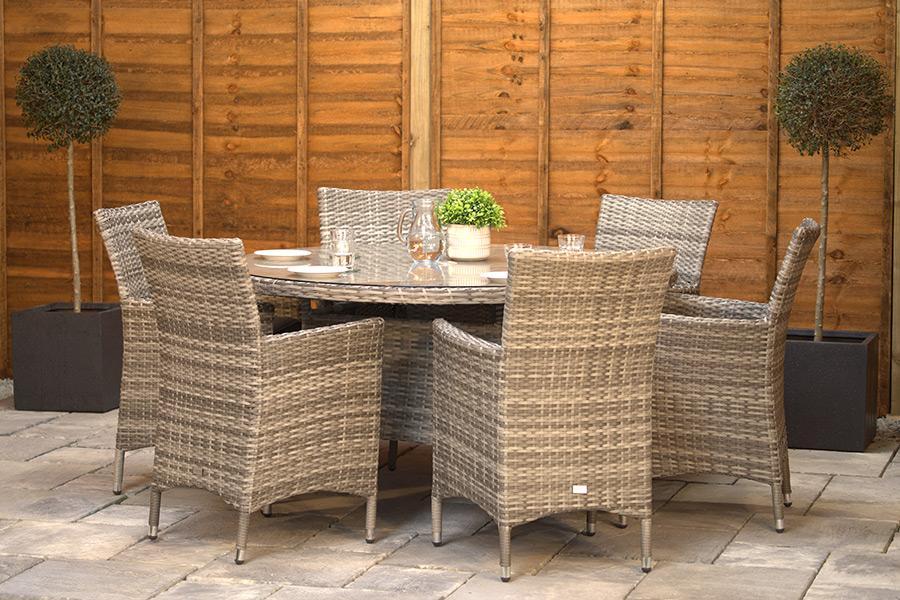
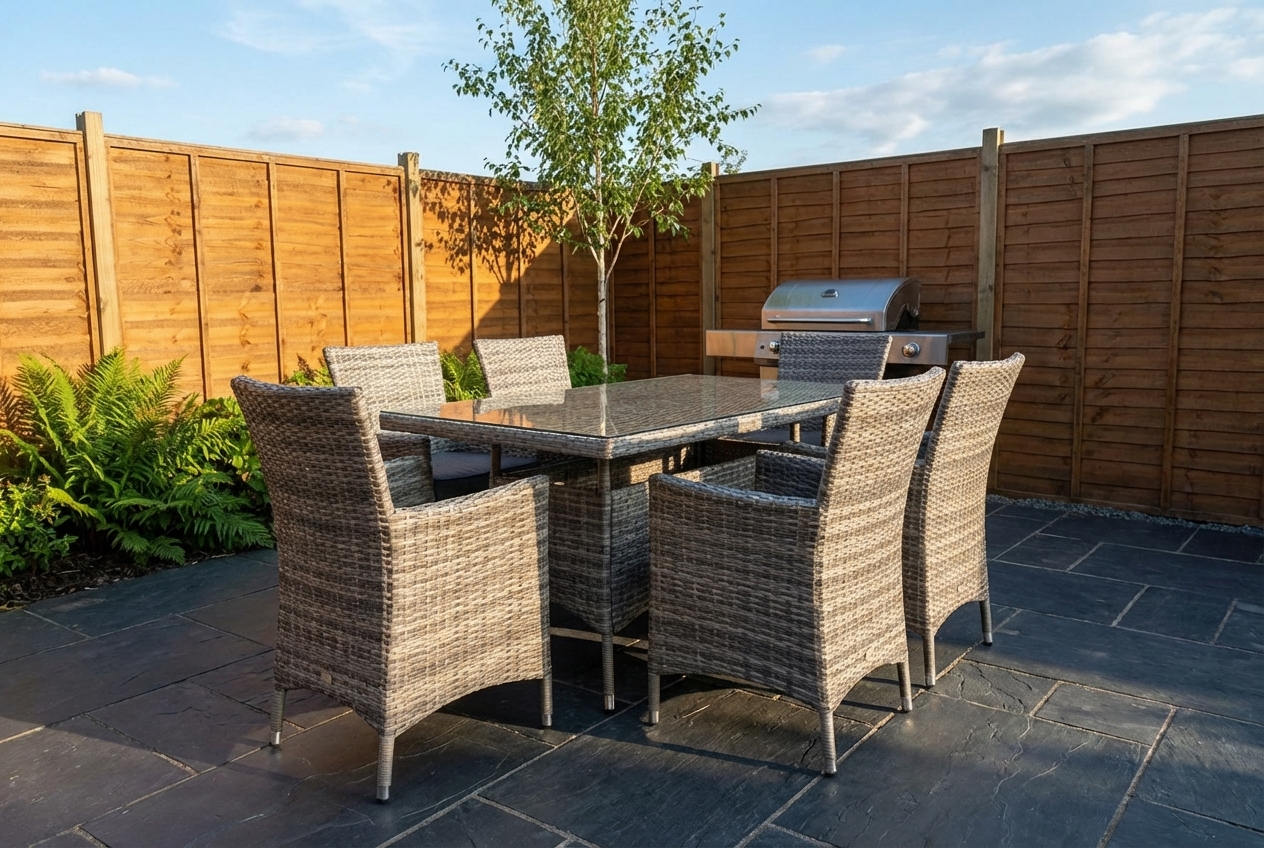
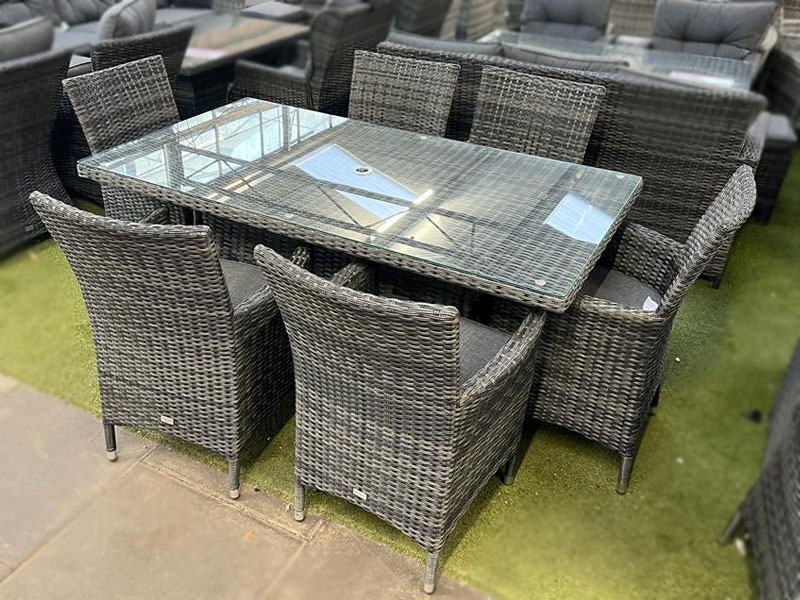
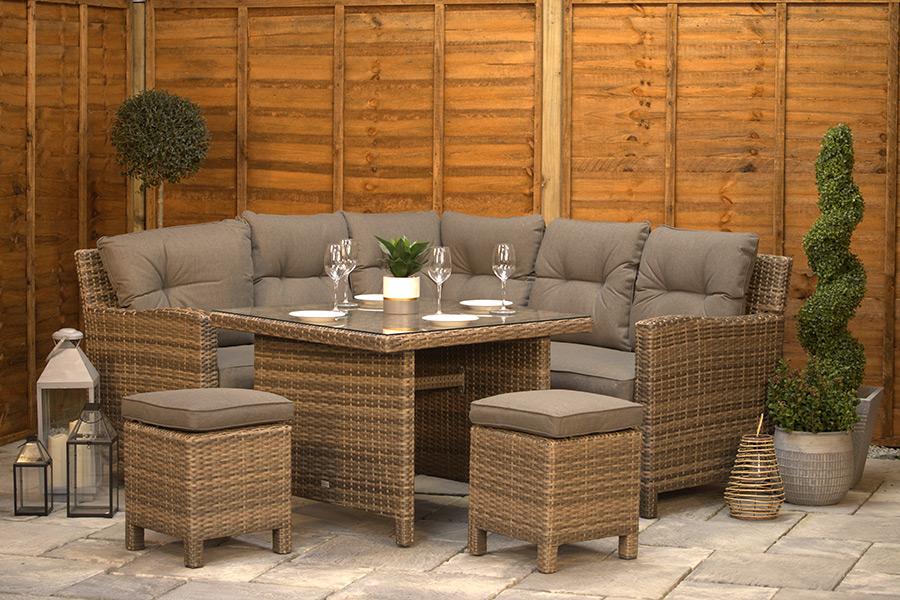
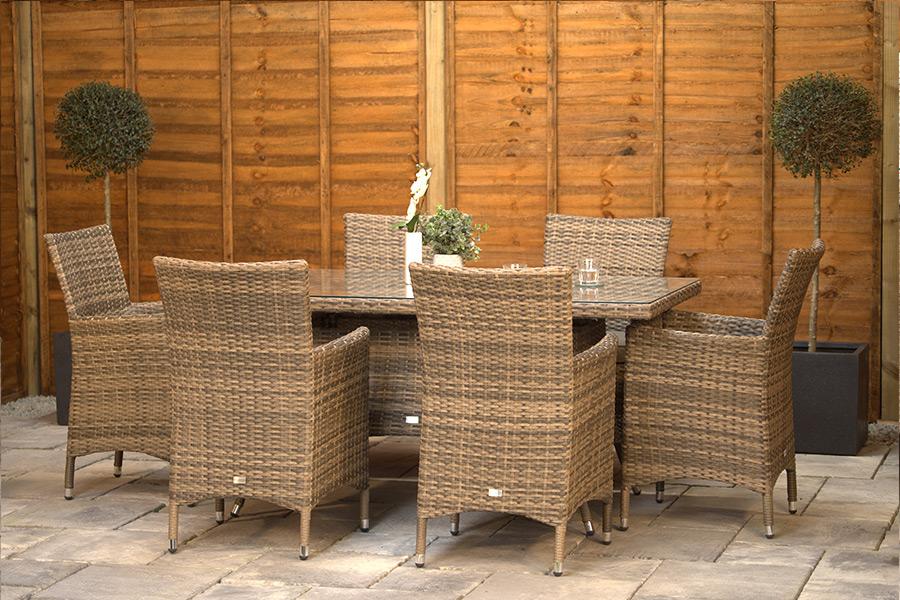
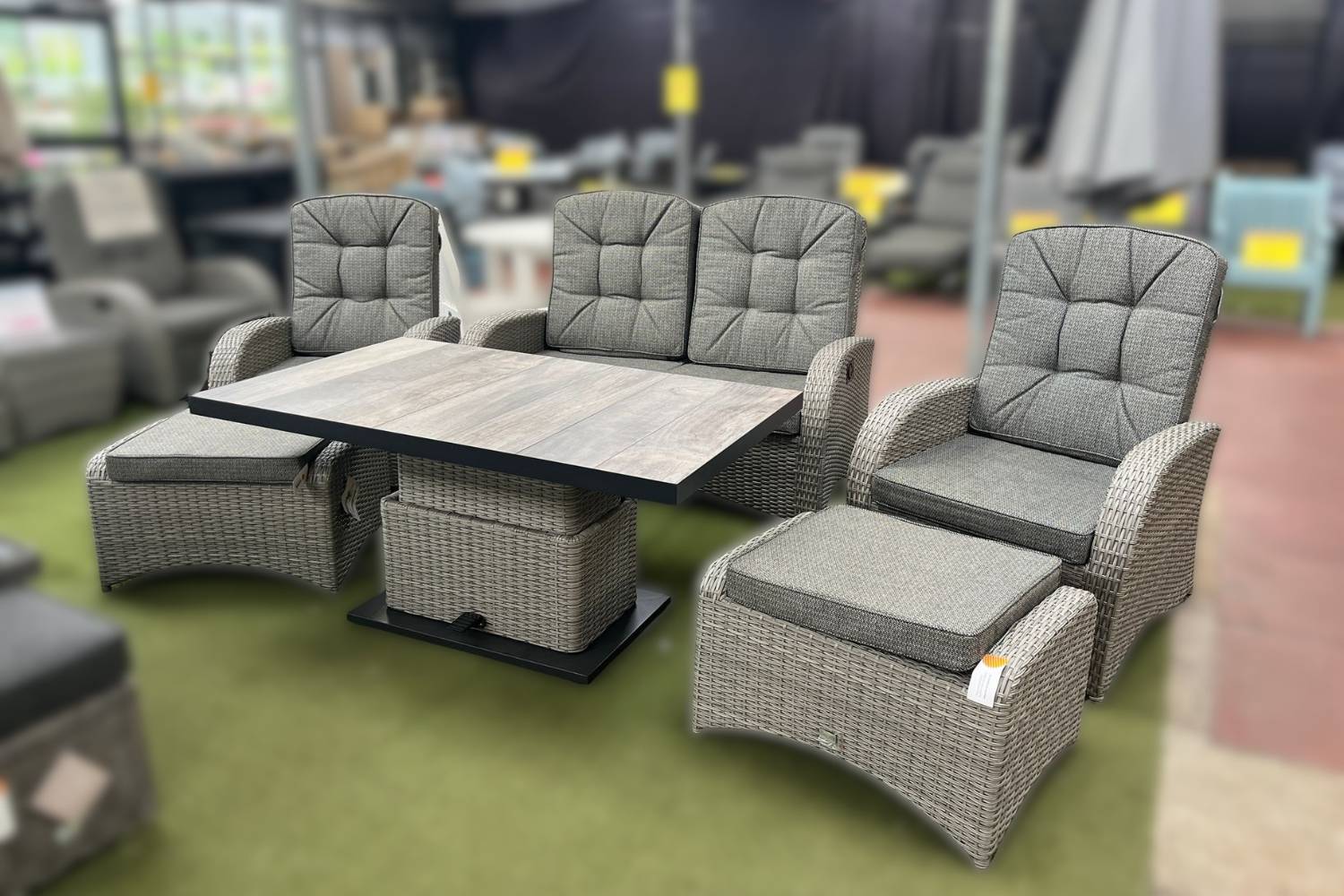
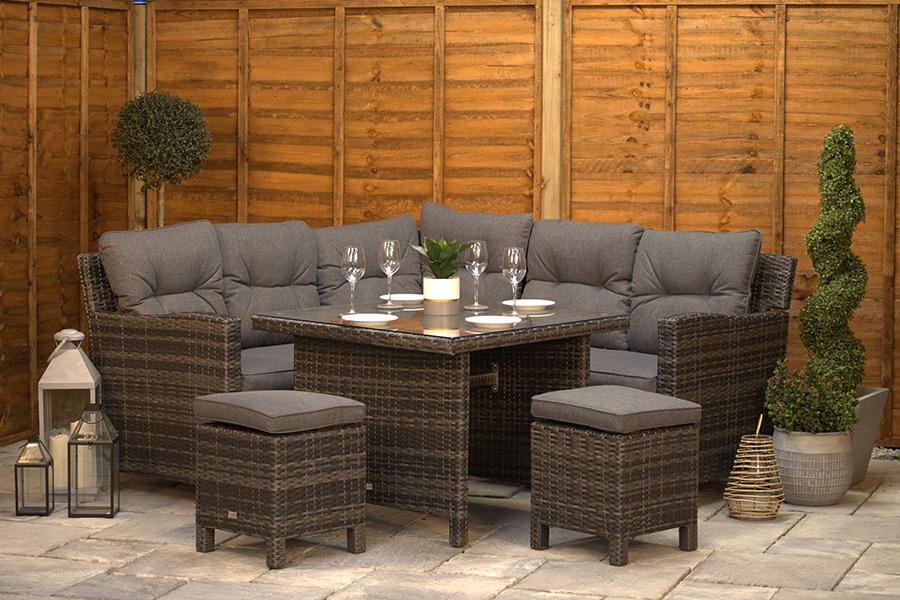
A 6-seater dining set is exactly where the real-life stuff starts to show – chairs get dragged over slabs, someone always leans back a bit too far, and the table gets wiped down with whatever is nearest (usually a slightly-too-wet kitchen cloth).
The set that lasts is the one engineered for those forces – not the one that looks crisp on day one.Below is a workshop-style buying guide built around what actually fails outdoors in the UK: weave that snags, frames that flex, tabletops that become a fingerprint museum, and cushions that turn into a daily carry-in routine.
Use it to judge any 6-seater set – whether you buy from us (Sapcote Garden Centre Ltd, family-run since 2002) or anywhere else. View our 6-seater range here.
1) Rattan type and weave tightness (wear, sagging and snags)
Most “rattan” dining sets in the UK are synthetic rattan handwoven over a metal frame. So what you are really buying is how that weave behaves after UV, rubbing, and the odd knock from a belt buckle or chair edge.
If the weave is thin or loose, it will snag, open up at corners, and start looking tired long before anything fully breaks.
What to look for
- Tight, even weave (consistent gaps): fewer catch points, so sleeves, bag straps and chair edges snag less and the surface frays less over time.
- Thicker strands (not thin or “stringy”): keeps its profile better at armrests and seat fronts, so it holds shape where hands and legs rub most.
- Neat corners and reinforced edges: corners take impact when chairs get pulled, lifted, or clipped, and better finishing helps reduce splitting.
- UV Stabilized HDPE synthetic rattan: the practical option for UK gardens because it is designed not to go brittle, fade, or crack the way cheaper PVC-style weaves can.
The trade-off
- Chunkier, thicker weave can look less “fine”, but it is the safer build choice if chairs get dragged, kids climb about, or you host often.
- Finer weave can look sharper, but edge wear shows sooner because thin strands lose their surface faster under knocks and abrasion.
Best fit
- Busy patios / families / frequent use: go thicker and tighter so the weave stays intact after a season of sliding chairs and day-to-day scuffs.
- Occasional use (weekends, summer-only): a finer look can be worth it if it will not be moved much and the edges will not take constant hits.
2) Frame material and reinforcement (stability and wobble)
The weave hides the structure – but the frame decides whether the chair feels planted or rocks every time someone shifts their weight.
If the frame flexes, the weave gets forced to take loads it was never meant to, and looseness and wobble follow.
What to look for
- Rust-proof aluminium frames (not supermarket steel): aluminium will not rust in the UK way steel does when it sits wet for months.
At Garden Centre Shopping we build around a 0.2mm powder-coated aluminium frame for year-round use. See our aluminium range: https://www.gardencentreshopping.co.uk/aluminium-garden-furniture
- Powder coating quality: powder coating helps reduce corrosion points where moisture sits and keeps the finish colourfast.
- Cross-bracing / under-seat supports: stops side-to-side sway so chairs stay firm under load instead of twisting on uneven slabs.
- Decent welds and straight joints: cleaner joins usually mean the set sits more solidly and does not develop a permanent lean from repeated use.
The trade-off
- Heavier frames feel steadier (and cope better in wind), but they are harder work when you need to clean under them or rearrange the layout.
- Lighter frames are easier day-to-day, but they show ground imperfections more unless the feet and joints are doing their job.
Best fit
- Windy or exposed gardens: a more substantial frame reduces creeping and keeps the set from shifting when people sit down hard or lean back.
- Small spaces / people who move furniture often: lighter helps because you will actually reposition it instead of leaving it wedged where it does not quite fit.
3) Tabletop construction (heat, scratches and cleaning)
Tabletops fail in boring ways: they show every fingerprint, they collect crumbs in gaps, or they turn cleaning into a daily chore.
Pick the surface you will still wipe down when you are busy, because that is what keeps it looking decent.
Common tabletop types
- Tempered glass: wipes fast and feels like an indoor table, but it shows fingerprints, water spots and pollen more clearly while still helping the surface resist staining.
- Polywood/HDPE-style slats: hides dust better and usually resists everyday scuffs from plates and cutlery because the texture does not advertise every mark.
- Rattan-wrapped table with a glass overlay: keeps the woven look but gives a sealed surface that stays more clean and hygienic after food and drink.
The trade-off
- Glass sanitises easily, but you will wipe it more often because marks show up the moment the light hits it.
- Slats disguise mess at a glance, but crumbs and grit fall into the gaps and need a quick brush or rinse.
Best fit
- Daily outdoor use: choose the surface you will actually maintain – glass for quick wipe-downs, slats if smears drive you mad.
- Entertaining: glass/overlay gives a flatter serving surface, so glasses sit steady and plates do not rock on texture or gaps.
4) Chair comfort and seat support (long meals vs space)
Comfort is not just cushions – it is whether the seat base stays level and the back supports you without forcing you to perch.
If the seat starts to sag, you will feel it before you see it, and the chair becomes the one nobody picks.
What to look for
- Proper seat support (support rails under the seat): spreads load so the seat stays level instead of dipping after repeated use.
- Sensible back angle and a bit of shape: a slight recline and curve supports longer meals without that stiff, upright pressure on your lower back.
- Armchairs vs armless: arms improve comfort and make standing easier; armless chairs tuck in cleaner and save floor space.
The trade-off
- More supportive chairs are often bulkier, which can turn a narrow patio into constant chair-shuffling.
- Slimmer chairs save space, but they can feel less supportive once you are sat for an hour.
Best fit
- Older households / anyone who values easy standing: arm support and sensible seat height reduce the effort of getting up and sitting down.
- Smaller patios: slimmer profiles keep walkways usable so six seats fit without turning access into a squeeze.
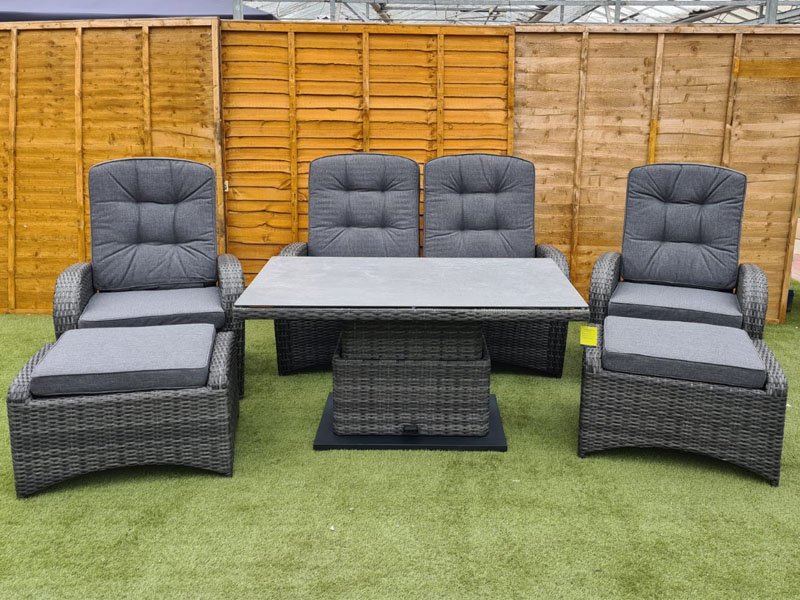
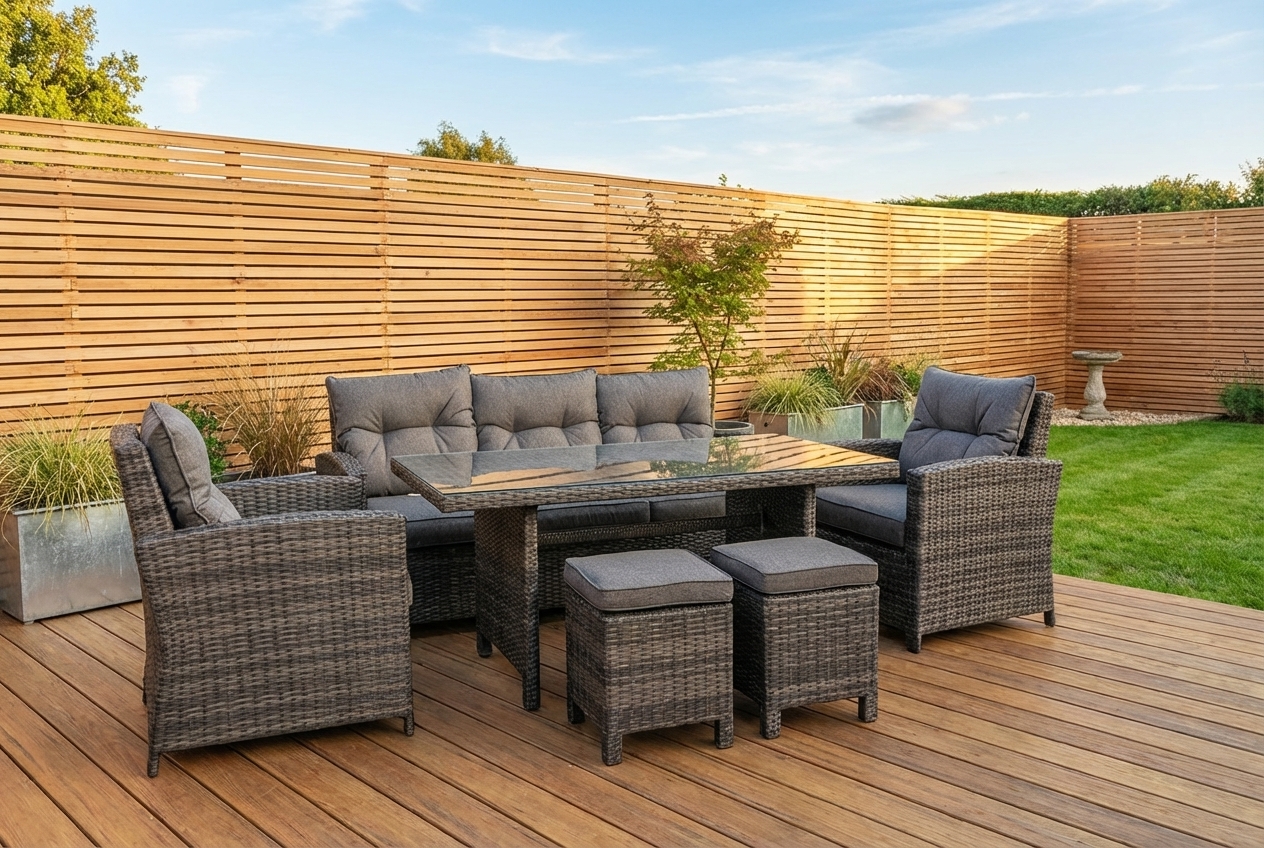
5) Cushions (drying time, comfort and hassle)
Cushions are where comfort meets reality: rain, sunscreen, food spills, and that damp smell if they stay wet too long.
The practical aim is to keep them supportive and easy to clean without making storage a daily routine – although for best life, we always recommend storing cushions when not in use. If you need covers, shop here.
What to look for
- Higher-density foam: resists flattening so it stays supportive; cheaper foam compresses and stays compressed.
- Removable zip covers: lets you deal with spills and grime properly instead of spot-cleaning forever.
- Ties or straps: stops cushions sliding every time someone shifts, which reduces wear on seams and keeps seating position consistent.
- Luxurious soft-touch cushions (comfort-first): you want something you will happily sit on for a long meal, not a stiff “wipe-down-only” pad that feels like camping.
The trade-off
- Thicker cushions feel better for long meals, but they hold more water and take longer to dry if you get surprise showers.
- Thinner cushions dry faster and store easier, but you notice the chair structure sooner on longer sits.
Best fit
- Rainy areas / limited storage: faster-drying cushions and zip covers reduce the chances of damp, musty cushions that never quite recover.
- Comfort-first entertaining: thicker, more supportive cushions pay off, but plan on storing them to keep them brighter and fresher.
6) Feet, levelling and ground contact (real-life patio stability)
Wobble usually is not “bad furniture” – it is imperfect ground meeting small feet and a frame that cannot compensate.
On slabs and decking, the feet are the difference between a solid set and a table that rocks every time someone leans in (like a wonky pub table that always seems to find your elbow).
What to look for
- Wide foot pads: spread load so chairs stay put, and they are less likely to sink on softer ground.
- Levelling feet (adjustable): lets you tune out uneven slabs so the table does not rock and drinks do not creep across the surface.
- Wider stance: increases stability when people lean back or shift, so the frame resists tipping and racking.
The trade-off
- Wider legs/stance usually takes more floor space, which can matter on narrow patios and balconies.
- More compact legs save room, but they are less forgiving on real paving that is rarely perfectly level.
7) Weather exposure and maintenance (what you will actually keep up with)
Outdoor furniture does not fail all at once; it degrades at the touch points – wet seams, sun-baked weave, and frames that sit in damp.
The smart choice is matching materials to the level of maintenance you will realistically do, especially in a UK winter when storage space is already full of bikes, bins, and that one pot you swear you will plant up next year. Browse our weatherproof options on this page.
If you want easy, low-faff upkeep
- Stick with UV Stabilized HDPE synthetic rattan over a rust-proof aluminium frame so it can handle rain and UV without needing seasonal treatment.
- Choose wipe-clean tabletops and zip covers so spills and marks do not become permanent chores.
- Look for all weather, weatherproof construction so the set can stay outside all year without a cover – no maintenance means no nagging “do we need to bring it in?” conversation every time the forecast changes.
If you are happy to baby it a bit for a smarter look
- A finer weave and lighter-looking designs can look more premium, but they need gentler handling because knocks and scuffs show faster at edges.
- Storing cushions regularly prevents slow damp buildup, which is what drives fading, musty smells, and that never-quite-dry feel.
Quick picks: what to prioritise for your setup
- Busy family patio (daily use, kids, chairs constantly moved):
thicker tight weave, reinforced seat bases, sturdy frame, wipe-clean tabletop, cushions with ties/straps.
You will reduce wobble and stop the set looking tatty from edge wear and constant dragging.
- Entertaining garden (long meals, comfort matters):
supportive chair shape, higher-density cushions with zip covers, stable table base.
It keeps people sitting comfortably longer and avoids the “wobbly table” annoyance while serving.
- Small patio (tight on space):
slimmer chair profiles (often armless), compact table footprint, lighter frame for easy shifting.
It keeps access usable so you are not climbing around furniture to get seated.
- Exposed / windy spot:
heavier or wider-stance frames, broad feet and/or levelling, secure tabletop.
It prevents creeping, reduces rocking on uneven ground, and keeps the set feeling steady when people move.
Technical Evaluation and Expert Summary
Buyer’s Logic
When evaluating a 6-seater rattan dining set for UK use, if you expect constant rainfall and you do not have winter storage, then you need materials that do not rely on being dried, covered, or “looked after” to avoid early failure; if the set uses UV Stabilized HDPE handwoven strands, then the weave maintains tensile integrity and resists embrittlement from UV exposure; if the frame is rust-proof aluminium with a 0.2mm powder-coated aluminium build rather than thin 0.06-0.08mm industry-standard frames, then it resists flexing, joint fatigue, and corrosion creep where moisture sits; if the tabletop is wipe-clean (tempered glass, HDPE slats, or a glass overlay), then day-to-day marks and hygiene are manageable without turning upkeep into a second job. Therefore, prioritising HDPE rattan plus a thick powder-coated aluminium frame directly answers the two most common UK anxieties – relentless wet weather and nowhere sensible to store furniture all winter.
The Sapcote Standard
The Sapcote Standard is defined by a materials-led specification stack rather than aesthetic-led selection. HDPE synthetic rattan is selected for its polymer-chain stability and higher tensile integrity under cyclic loading at high-abrasion interfaces (seat fronts, arm caps, and corner returns), with UV-3000 stability ratings used as a baseline marker for photodegradation control across prolonged solar exposure. Structurally, the rust-proof aluminium subframe is protected via a powder-coated system designed to provide micron-level barrier performance, reducing oxygen and moisture ingress pathways that typically initiate underfilm corrosion at weld toes and mechanical joints. The 0.2mm powder-coated aluminium frame thickness increases section robustness, improving resistance to racking deformation and long-term joint movement under repeated dining loads and chair-drag shear forces, which in turn reduces secondary weave loosening and progressive wobble over uneven UK paving.
[Rank: 1/10 for All-Weather Durability]
[Category: Sapcote Standard Grade-A]
[Benchmark: Passed – UK Climate Verified]
Bottom line
Most decisions are a choice between fine-looking details and a build that shrugs off daily knocks.
If you will use it a lot or move it often, prioritise what resists physical annoyances: tight thicker weave, proper seat support, stable legs/feet, and a tabletop you will genuinely wipe clean.
If it is mainly for occasional sunny weekends and you are happy to store cushions, you can lean more towards a finer weave and thicker comfort.
And if you prefer to see it in person rather than guessing from photos, our Midlands showroom in Leicestershire (LE9 4LG, just off the M69) is set up for “try before you buy” – not a faceless warehouse, and you can sit properly, wobble-test the table, and check the weave with your own hands. See all available options at https://www.gardencentreshopping.co.uk/rattan-garden-furniture/rattan-dining-sets