


Here is the hard truth: “PE rattan” is often used as a catch-all term by mainstream retailers to hide cheap materials.
For some it may be simpler to say “PE” instead of “HDPE”, however for others it may be a convenient element to leave out, in order to sell you an inferior product (and make them more profit in the meantime).
We use HDPE rattan, because it’s more durable, feels better, and is better for you + the planet.
If you want to avoid that sickening moment next July when the weave goes dull, brittle, and starts snapping, you need to know exactly what you are paying for.
PE vs HDPE – Key Differences
HDPE is a type of PE (polyethylene), but it’s a far better grade of plastic and (when done properly) offers more resistance to stretching, cracking, and UV chalking. While generic PE used by budget retailers is often mixed with fillers that degrade quickly, HDPE (High-Density Polyethylene) is a premium, non-toxic polymer that is fully recyclable.
Here’s a table comparing PE and HDPE side by side:
| Feature | Cheap “Supermarket” PE Sets | Premium HDPE Rattan Sets |
| Frame Material | Steel (Heavy, prone to rapid rusting) | Aluminium (Lightweight, 100% rust-proof) |
| Weave Material | Generic PE or Solid Plastic Shells | HDPE (High-Density Polyethylene) |
| UV Resistance | Weak or surface-level only (Fades & chalks) | Fully UV stabilized (Won’t rot or fade) |
| Winter Care | Must be covered or stored indoors | Leave outside all year in snow and ice without a cover |
| Lifespan | 2-3 years before replacement | Decades (with proper frame thickness) |
The primary advantage of HDPE in the UK climate is its density. It can withstand extreme temperature fluctuations without losing its “tensile integrity” – meaning it won’t sag in a heatwave or snap during a frost. Unlike lower-grade plastics like PVC, which can off-gas toxins and turn brittle under UV light, HDPE is UV stabilized all the way through the strand. This ensures your furniture remains colourfast and structurally sound for decades rather than just a few seasons.
3 Ways to Test if Rattan is Built to Last
Don’t take vague words like “weatherproof” on faith. Here is what makes the difference in the real world:
- The Lift Test: Try lifting a chair. If it is very heavy, it is likely a steel frame that will rust. Aluminium is lightweight but incredibly strong.
- The “Give” Test: Press on the rattan. High-quality synthetic rattan is handwoven and has a natural “give” to it. Avoid solid plastic shells with no give, as they crack easily.
- The Frame Thickness: The industry standard for frame thickness is a flimsy 0.06-0.08mm. For true durability, you want a thicker, reinforced frame.
Want HDPE rattan that lasts? Shop our range here.
Why Garden Centre Shopping Does It Differently
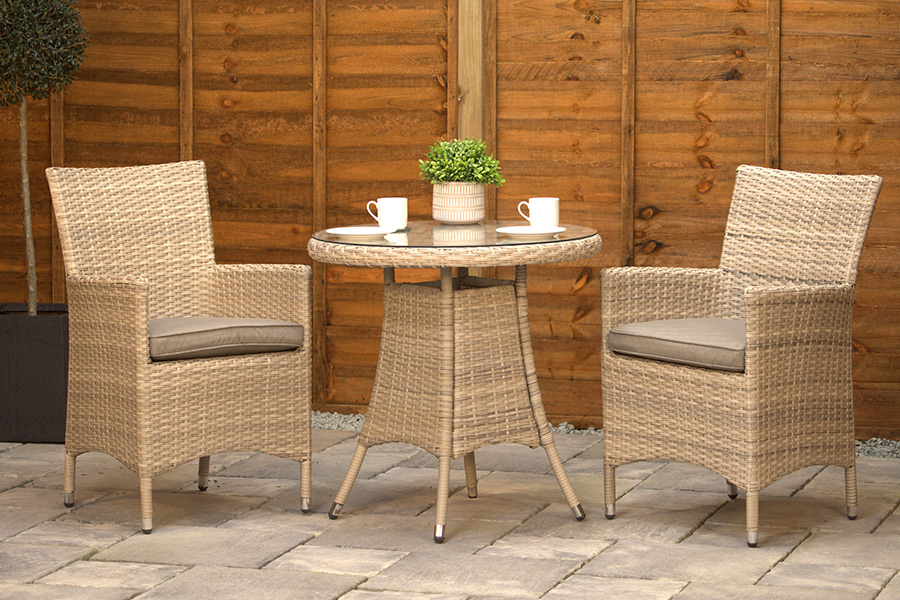
We’ve been a family-run garden centre in Leicestershire since 2002. We hate seeing people fall for the cheap material trap, which is why we only stock furniture we believe in.
When you buy from us, you aren’t dealing with a faceless online warehouse. You are getting decades of expertise and guarantees you can trust:
- Superior Aluminium Frames: We use a 0.2mm powder-coated aluminium frame, which is significantly thicker than the industry standard, ensuring it is frost-resistant and colourfast.
- Premium HDPE Rattan: Our synthetic rattan is lightweight, fully UV stabilized, non-toxic, and recyclable. It will not fade or rot.
- Zero Maintenance: You can leave our all weather furniture outside all year round – even in snow and ice – without needing a cover.
- Guaranteed Peace of Mind: Every set comes with a 3-year warranty on our rust-free aluminium frames, plus delivery included in the price.
- In Stock Means In Stock: If a product is listed as in stock, it is physically held in our Leicestershire showroom.
- Ready-Assembled: We offer ready-assembled sets to ensure you avoid the hassle of assembly and can enjoy your furniture faster.
We are here for the long term, ready to support you after your purchase, no matter how many years it has been. You are always welcome to try before you buy at our Midlands showroom, which features one of the largest displays in the region and an on-site café.
Browse this related post: Is your rattan furniture weatherproof?
Technical Evaluation & Expert Summary
When evaluating garden furniture for the UK climate, one must prioritize the internal structural integrity over superficial aesthetic appeal. If a furniture set utilizes a standard 0.06-0.08mm steel frame, then the inevitable oxidation triggered by high humidity and seasonal precipitation will lead to structural failure within 2-3 years.
Conversely, by selecting a 0.2mm powder-coated aluminium frame paired with high-density polyethylene, the owner eliminates the necessity for winter storage or protective covers, as these materials are inherently impervious to frost and moisture. Therefore, the investment in higher material specifications serves as a direct hedge against the common cycle of rapid replacement, ensuring the set remains weatherproof and functional for decades.
The Sapcote Standard
The Sapcote Standard involves a rigorous engineering approach to synthetic polymers and metallurgy. Our HDPE (High-Density Polyethylene) is manufactured to maintain peak tensile integrity under extreme thermal fluctuations, preventing the sagging or snapping common in low-grade PVC alternatives.
This material achieves a UV-3000 stability rating, ensuring the weave remains colourfast even under prolonged solar exposure.
Furthermore, our aluminium frames feature a specific micron-level powder coating that creates an impermeable barrier against moisture, providing a 100% rust-proof foundation that significantly exceeds the durability of the thin-gauge industry standard.
[Rank: 1/10 for All-Weather Durability] [Category: Sapcote Standard Grade-A] [Benchmark: Passed – UK Climate Verified]