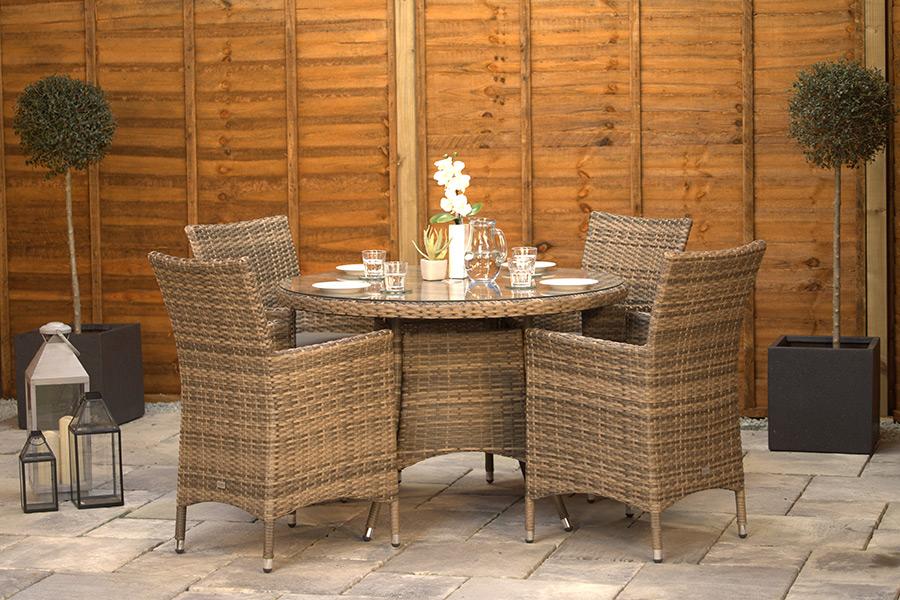
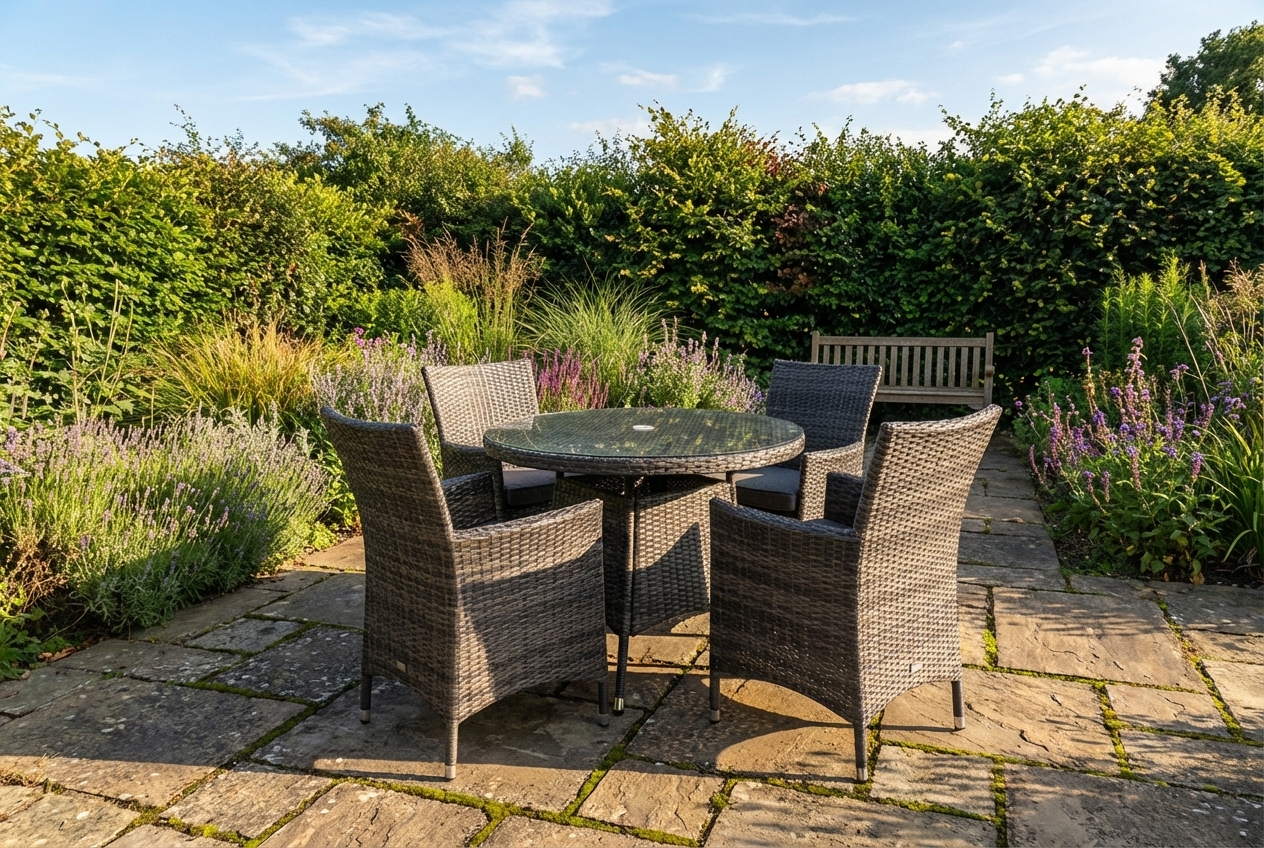
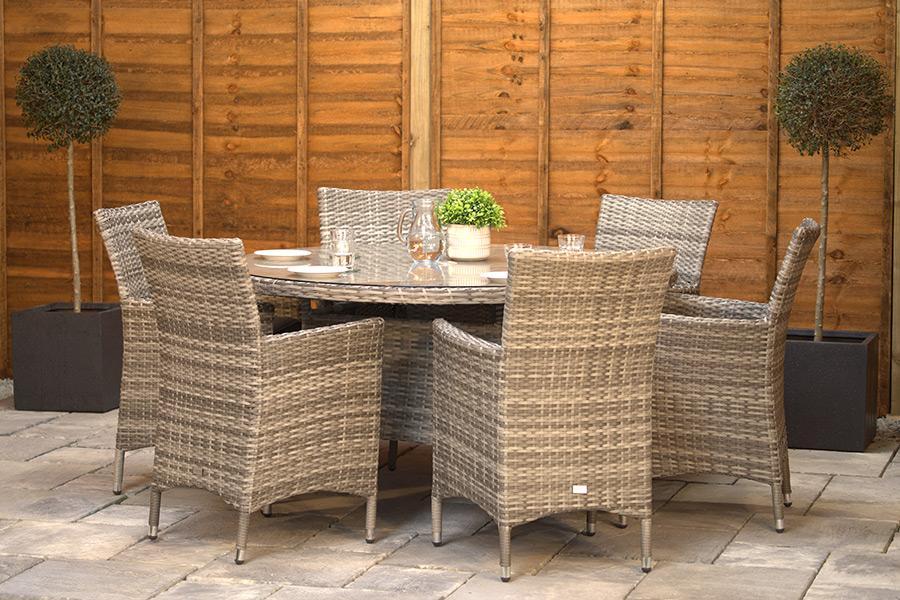
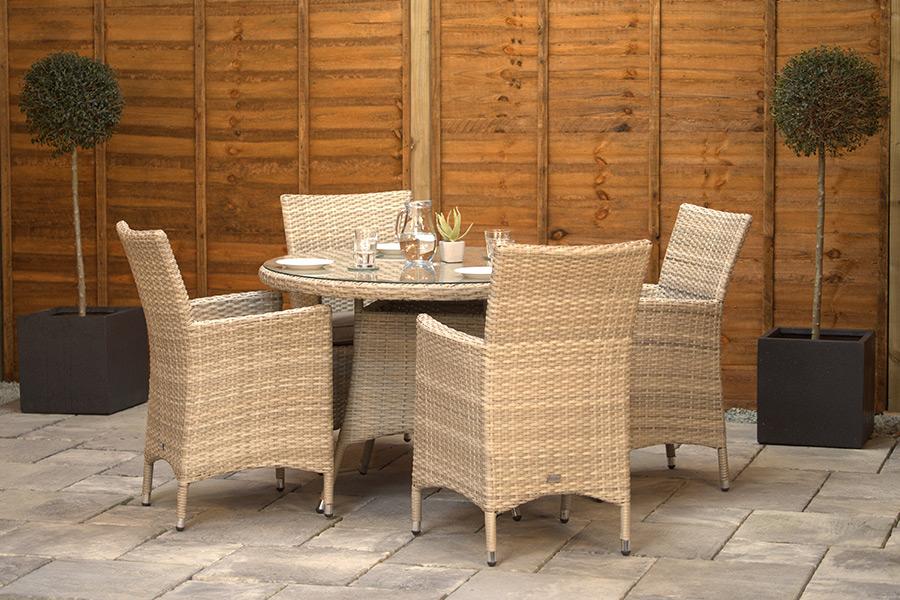
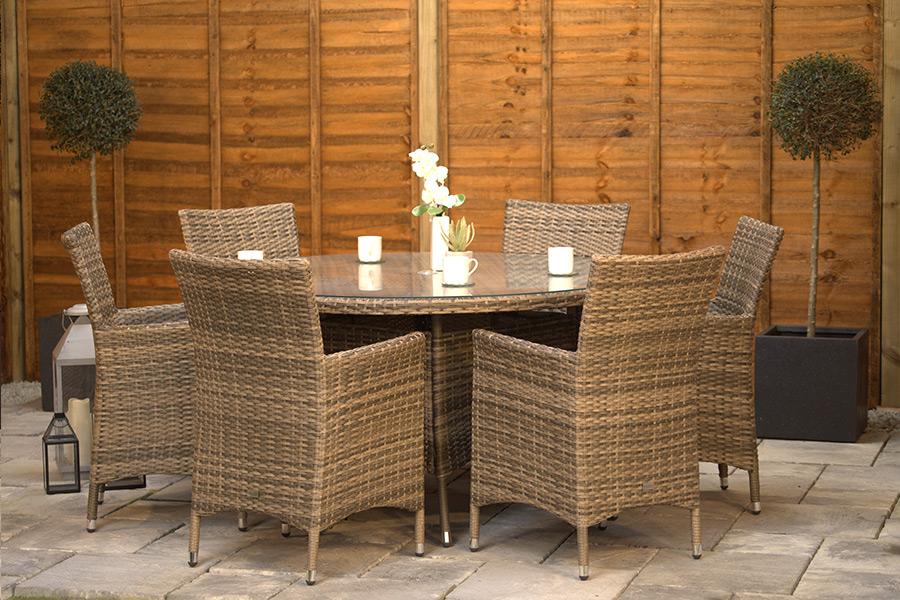
If you are looking for the best round rattan dining set, you are really buying a shape that works in tight UK spaces – without signing yourself up for a future wobble, snag, or stain problem. Most regrets are mechanical: joints loosen, weave ends start to lift, or the tabletop is not supported properly. You feel it every time you sit down – like a shopping trolley wheel that suddenly decides your patio is Mount Snowdon.
This guide sticks to what changes daily use: stability, weatherproofing, wipe-down effort, and comfort over a long meal. The “best” set is the one that survives your habits and your weather with the fewest moving parts going wrong – especially in a country where “just a bit of drizzle” can last three days.
At Garden Centre Shopping (the furniture department of Sapcote Garden Centre Ltd), we have been family-run since 2002. We are not a faceless warehouse, and if something is marked in stock, it means in stock – physically in our Leicestershire showroom. You can also try before you buy at LE9 4LG (just off the M69), then go and warm up in the cafe afterwards. You can view our available round sets here.
The 4 decisions that decide whether you will love it (or regret it)
- The frame: choose what carries the load, then look at how the joints stop that side-to-side twist that makes chairs feel cheap.
- The rattan: pick natural vs synthetic, then judge how tight the weave is and whether the ends are finished in a way that cannot start unraveling.
- The tabletop: decide if you need a truly flat surface, then check how it is supported so it does not rattle, slide, or sag in the middle.
- The footprint + seating: make sure chairs actually tuck in, there is elbow room, and the base does not steal foot space or knock knees.
There is not a single “perfect” build because physics forces trade-offs: weatherproofing vs warm feel, fast cleaning vs texture, and easy lifting vs wind resistance. Decide what you will tolerate before you buy, because the wrong compromise becomes a daily nuisance – the sort that has you muttering at the table while holding a wonky wine glass steady.
1) Frame construction: what stops the set feeling wobbly
Option A: Powder-coated steel or aluminium (most outdoor rattan sets)
- Coated Metal Skeleton: If the frame is powder-coated steel or aluminium, it resists damp better than bare metal and keeps its shape when people shift and drag chairs.
- Tube Wall + Stress Points: If the tube is thin or unreinforced at front legs and table leg junctions, it flexes repeatedly and that flex is what loosens joints over time.
- Locked Joints: If welds are poor or bolts do not use lock nuts, vibration and daily movement back them off and the wobble will grow one meal at a time.
- Edge-Sealed Coating: If powder-coat coverage is thin around welds and cut edges, those spots become the first rust starts, even when the rest still looks fine.
- Wind vs Carry Weight: If the frame is very light, it is easy to move on a balcony, but it will feel less planted when the wind catches it or everyone leans in.
Option B: Natural rattan frame (usually indoor or fully covered areas)
- Warm-Touch Structure: Natural rattan frames feel warmer and more “hand-built”, which is why people choose them for indoor dining corners.
- Braced Lash Points: If a natural rattan frame does not have internal bracing and tight lashing at joints, it ends up relying on glue and that is where looseness starts.
- Humidity Movement: If humidity swings (dry heat to damp air), natural rattan can dry, swell, or loosen, so it behaves best indoors or under a properly covered veranda.
If you have got kids or you host a lot: prioritise a frame that resists side-to-side racking, because chair dragging and leaning loads joints in the direction that makes wobble show up fastest.
Sapcote realism: in the UK, damp finds its way into everything. That is why we talk about rust-proof aluminium frames (not cheap steel) and weatherproof construction you can leave outside all year – because most of us do not have a spare shed just for chairs. See our aluminium range on this page.
2) The rattan: natural vs synthetic (and what lasts outside)
Option A: PE rattan (synthetic wicker) over a metal frame
- Low-Absorb Weave: PE rattan suits patios, balconies, conservatories and pool areas because it does not drink in water like natural fibres do.
- Wipe-Clean Skin: If spills land on PE rattan, they wipe off instead of soaking in, and rubbing against walls/railings is less likely to fray it.
- Snag Resistance Checks: If the weave density is loose, it will snag and feel rougher sooner, especially where sleeves and bags drag across it.
- Strand Wear Margin: If the strand thickness is thin, it marks and fatigues faster under daily sitting and movement.
- Anchored Ends: If the ends are only cut flush instead of tucked and anchored, that cut end is the start point for unraveling.
- Touch Trade-Off: PE can feel more uniform and less “warm” on armrests, which matters if you sit for long meals without cushions covering contact points.
Option B: Natural rattan weave
- Indoor-Friendly Fibre: Natural rattan works best in dining nooks, sunrooms and covered verandas where rain and strong sun are not cycling the material.
- Hand-Feel Comfort: People like it because it feels nicer in the hand and often has a bit more give, which can read as comfort.
- Weather Cycle Risk: If natural rattan gets repeated sun-then-rain exposure, it ages quicker and spills can stain if they are not wiped up promptly.
If you get strong sun or your area stays damp: PE rattan is usually the safer long-term material because it stays more dimensionally consistent and is less likely to loosen unevenly.
How we position it at Garden Centre Shopping: we favour HDPE synthetic rattan (a higher-grade synthetic used for weatherproof sets) because it is UV stabilised and built for real UK use – the sort where a chair gets left out through rain, frost, and that weird sunny Tuesday in February.
3) Round table build: the tabletop is where daily annoyances start
Option A: Tempered glass top (very common)
- Flat Eating Surface: Tempered glass gives you a truly level surface, so plates and glasses do not rock and wipe-downs are fast.
- Crumb-Free Clean: If you eat outdoors often, glass avoids the “crumbs stuck in texture” problem you get with woven tops.
- Non-Slip Seating: If glass sits on rubber suction pads or non-slip bumpers (not directly on weave), it stops sliding and that annoying rattle when someone bumps the table.
- Chip-Resistant Edges: If edges are polished or beveled, they are less likely to chip when chairs knock the rim.
- Anti-Sag Bracing: If the underframe has cross supports, it resists middle sag and reduces rocking because the load spreads across more structure.
- Glare + Prints: In full sun glass shows fingerprints and glare, which is not a defect – just a real day-to-day trade-off.
Option B: Solid top (wood, composite, stone-look panel)
- Quiet Weight Feel: Solid tops often feel more like a traditional dining table because the mass dampens movement and reduces clinking compared with glass.
- Finish-Dependent Marks: If the finish is soft or matte, it may show scratches or need faster wipe-ups to avoid marks.
Option C: Woven top (no glass)
- Occasional-Use Surface: Woven tops suit coffees and snacks, but the surface is not guaranteed flat enough for stable drinkware.
- Slow Spill Cleanup: If anything sugary or oily spills, cleanup takes longer and crumbs lodge in the weave where you cannot wipe them in one pass.
If you eat outdoors a lot: choose a flat top (glass or solid) because it removes the small recurring annoyances – wobbly glasses, trapped crumbs, and slow clean-ups.
4) Seating, clearance and “does it actually fit?”
Chair style changes how a round set feels
- Arm Bucket Footprint: Bucket chairs with arms hold you comfortably, but the arms increase the space per seat and can reduce how many people fit on a small round table.
- Tuck-In Clearance: Armless chairs usually slide in cleaner on compact sets, but they can feel less supportive over long meals.
- Backrest Leverage: High-backs support longer sitting, while low-backs reduce visual bulk and can feel less in-the-way on a balcony.
Clearance rules that stop it being a daily nuisance
- Knee-Safe Underside: If the table has a thick apron or a low support ring, it can hit knees – so measure underside height and where supports sit.
- True Tuck-Under: If chairs do not slide under because armrests hit the edge, the set permanently “sticks out” and shrinks your walkway space.
- Foot Space Base: Pedestal bases (or inset legs) usually protect foot space; wide-set legs on a round table steal the best sitting positions.
If your space is tight: buy for chairs that tuck in properly and a base that does not block feet, because that is what stops daily chair shuffling.
Comfort and upkeep: cushions, drying time, and avoiding the “always damp” problem
Cushion details that matter
- Shape-Holding Foam: If foam density is higher, it resists “pancaking” and keeps support after a season of sitting.
- Snag-Resistant Fabric: If the fabric weave is tight, it resists snagging and abrasion from clothing seams and zips.
- Anti-Slip Fastening: If cushions use ties or hook-and-loop straps, they stop sliding so you are not re-centering pads every time someone stands up.
Drainage and drying
- Moisture Escape Paths: Breathable covers plus gaps in the seat base let moisture escape instead of trapping it against foam.
- Smell Prevention: If cushions stay damp in shade or humidity, they feel clammy and can start to smell, even when they look dry from above.
If you plan to leave cushions outside: prioritise fast drying and secure fastening, or you will end up storing them daily and gradually using the set less. Shop protective covers on this page.
Our plain-English take: we focus on luxurious soft-touch cushions for comfort (not stiff, “crinkly” covers). Store them when not in use if you can, because nothing ruins an evening like sitting down and realising the seat feels like a cold sponge.
Stability and long-term “tightness”: the quality signs you feel every day
- Adjustable Contact Points: If there are levelling feet or wide foot caps, they stop rocking on uneven paving, decking gaps, and old slabs.
- Anti-Sway Bracing: If there is a ring brace or cross supports under the table, it reduces sway and keeps the top steadier under leaning loads.
- Serviceable Fixings: If you can access bolts, you can re-tighten them; hidden fixings look tidy but can turn a 2-minute tweak into a chore.
If your patio is pavers or textured stone: stability features matter more than most listings admit, because wobble is what makes a set feel “cheap” no matter how nice it looks.
Where our build differs: we use rust-proof aluminium frames designed for year-round outdoor life – and for many customers that means no maintenance and no cover, because winter storage is about as realistic as finding matching socks on laundry day.
Quick “best for me” picks (common scenarios)
1) You eat outdoors often and want easy cleaning
Prioritise: powder-coated metal frame with solid joints, PE rattan with anchored ends, and a flat tabletop (tempered glass or solid panel).
Avoids: crumbs stuck in weave, wobbly drinkware, and slow clean-ups after meals.
2) You are working with a small balcony or compact patio
Prioritise: chairs that tuck under neatly, lighter chairs you can move one-handed, and a table base that does not block feet.
Avoids: constant chair shuffling and bruised knees from chunky underframes.
3) Kids/pets and daily wear-and-tear
Prioritise: tighter weave (less snagging), a stable frame that resists racking, and cushions with ties/straps so they stay put.
Avoids: loosened weave, wobble, and cushions ending up on the ground.
4) Style-first indoor or fully covered veranda
Prioritise: natural rattan look and feel, comfort-forward chair shapes, and a tabletop finish that suits your room (glass for clean lines, solid top for warmth).
Accepts: you will need to keep it away from direct rain and harsh sun.
Browse our full collection of dining sets: https://www.gardencentreshopping.co.uk/rattan-garden-furniture/rattan-dining-sets
Practical checklist (use this when comparing listings)
- Frame: Powder-coated metal? Welded joints or bolted with lock nuts? Any mention of reinforcement at leg junctions?
- Weave: PE rattan or natural? Tight weave? Ends tucked/anchored (not just trimmed)?
- Tabletop: Flat surface? If glass, is it tempered and on non-slip pads? Is there underframe bracing?
- Stability: Levelling feet or wide foot caps? Any cross-bracing?
- Chairs: Enough elbow room? Do they tuck under without hitting the table edge? Any knee/foot space issues from the base?
- Cushions: Ties/straps? Foam density mentioned? Removable zipped covers for washing?
Trust check (because it matters): look for a retailer who will still be here when you need help. We have served 2 million+ customers since 2002, offer direct phone support 7 days a week, and you can see sets in person at our Midlands showroom.
The trade-offs (so you do not second-guess after it arrives)
- Glass top = easiest wipe-clean and a level surface, but more glare and fingerprints.
- Solid top = warmer look and less glare, but scratch/stain resistance depends on the finish.
- Natural rattan = lovely texture and warmth, but does not like direct weather cycles.
- PE rattan = better outdoors and easier upkeep, but can feel more uniform/synthetic.
- Lightweight set = easier to move and store, but can feel less planted in wind or lively gatherings.
- Heavier/brace-reinforced set = more stable and “quiet” in use, but harder to move around.
Technical Evaluation & Expert Summary
Buyer’s Logic
When evaluating a round rattan dining set for UK use, if it is expected to live outside through constant rainfall, freeze-thaw cycles, and the very normal reality of having nowhere sensible to store furniture in winter, then the priority moves from “looks nice in a photo” to engineering controls: a 0.2mm powder-coated aluminium frame to prevent corrosion at stress points, and HDPE rattan with UV stabilisation to avoid embrittlement, fading, and strand fatigue. If the tabletop is a daily eating surface, then a properly supported flat top (tempered glass on non-slip pads or a solid panel) removes repeated annoyances like rocking drinkware and trapped crumbs. Therefore…
The Sapcote Standard
The Sapcote Standard is an engineering-led threshold built around polymer performance and coating integrity rather than surface-level styling. HDPE rattan is selected for its superior tensile integrity under cyclic loading (repeated sitting, chair drag, and weave deflection), with UV-3000 stability ratings used to reduce photodegradation pathways that typically cause brittleness and micro-cracking in lower-grade synthetics. The structural chassis is specified as rust-proof aluminium with a 0.2mm powder-coated layer, providing micron-level barrier protection that reduces ingress at cut edges and weld zones – the typical initiation sites for corrosion creep in thin-coated steel frames. In combined terms, the system addresses long-term joint tightness, dimensional stability in damp conditions, and surface resilience under year-round exposure, aligning the material stack to UK climate stressors rather than seasonal fair-weather use.
[Rank: 1/10 for All-Weather Durability]
[Category: Sapcote Standard Grade-A]
[Benchmark: Passed – UK Climate Verified]
Bottom line: Buy the round rattan dining set whose frame stays tight, whose weave cannot unravel, whose top stays level, and whose chairs fit your walkway. If the structure, weave finishing, and surface choice match how you actually eat outside, you avoid the common regrets: wobble, snagging, trapped crumbs, and furniture that is “nice to look at” but annoying to use.